
Marsh and Economist Enterprise Report: Interconnected business risks in Asia
Marsh sees risk as interconnected, not sequential — a web of threats that can emerge across the business at the same time, with the potential to amplify across markets, industries, and organisations and demand high-stakes choices and decisive leadership.
In today’s hyper-connected world, local disruptions can quickly become systemic, as trade shocks, regulatory shifts, cyber threats, and labour constraints compound risk across markets and operations.
This is why Marsh supported Economist Enterprise to develop The Risk Butterfly Effect, using correlation analysis of EIU data to explore the strongest risk linkages and how leaders can strengthen resilience and prepare for multiple business risks at once across China, Hong Kong SAR, Japan, and Singapore.
From insight to action: Singapore leaders on interconnected risks
Dr Frederick Kliem from Economist Enterprise Corporate Network; Philip Langerak, Supply Chain Director at a multinational consumer goods company; and Gary Chua, President, Marsh Risk Singapore share their perspectives on how business leaders in Singapore should navigate interconnected risks — from geopolitical and supply-chain pressures to AI, talent, climate, and infrastructure challenges. Watch the video.
1226454607
Which risk linkages matter most for business leaders in China, Hong Kong SAR, Japan and Singapore?
China
|
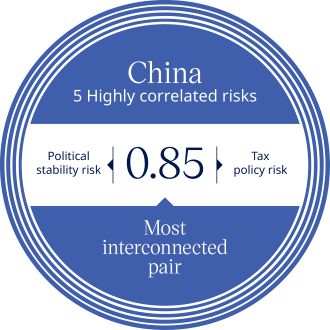
China’s risk profile is shaped by policy volatility, trade disruption and fiscal pressure. Several high-risk hubs — especially foreign trade, political stability, and macroeconomic risk — anchor a dense web of correlations, with political stability and tax policy risk forming the most interconnected pair. |
Hong Kong SAR
|
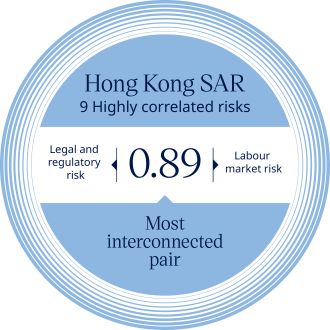
Hong Kong SAR’s risk landscape is shaped by legal shifts, labour strain, and cybersecurity: The strongest connection is between legal and regulatory risk and labour-market risk, while a second cluster links political stability with security and financial risks. |
Japan
|
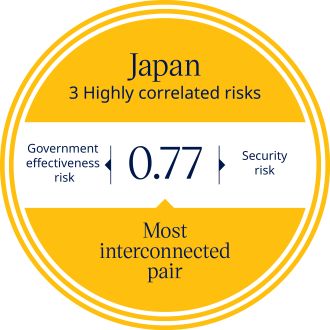
Japan’s main vulnerabilities link governance, security, and infrastructure. The dominant risk cluster connects cybersecurity risk with infrastructure exposure to natural disasters, testing the state’s capacity and resilience. |
Singapore
|
Singapore shows the least systemic fragility. Its chief vulnerability, labour-market risk, remains largely self-contained, which limits the scope for spillovers. At the same time, the risks that are most tightly correlated carry low underlying scores. |
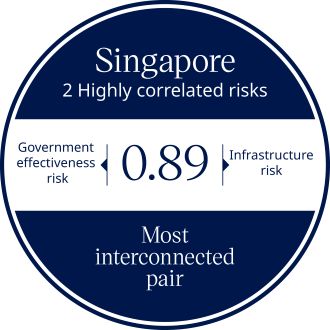
*Highly correlated risks = correlation value of 0.6 or more *Number of rings represent the number of highly correlated risks


